
NASA Outlines Accelerated Artemis Plans, Targeting a Return to the Moon in 2028


KENNEDY SPACE CENTER, FLORIDA — NASA is moving forward with an ambitious strategy to return American astronauts to the lunar surface by 2028, with a revised Artemis mission sequence designed to test critical spacecraft systems, strengthen partnerships with commercial providers, and reduce risks before attempting another human lunar landing.
During a press conference on October 23 at NASA's Kennedy Space Center, NASA Administrator Jared Isaacman, Associate Administrator Amit Kshatriya, and Artemis Program Manager Jeremy Parsons outlined the agency's approach to accelerating lunar exploration. The briefing provided new details about Artemis III, now planned as a crewed mission in low Earth orbit in 2027, and Artemis IV, which is being developed as the first Artemis mission to land astronauts on the Moon.

The announcement represents an important shift in how NASA intends to prepare for sustained human exploration beyond Earth.
A New Space Race

NASA Administrator Jared Isaacman opened the briefing by recognizing the thousands of people whose work makes human spaceflight possible. He then revisited the Apollo era, drawing comparisons between the rapid progression of missions that ultimately led to the first human lunar landing in July 1969 and the challenges facing NASA today.
During Apollo, each mission built upon the technical accomplishments of its predecessors. Apollo 9 tested the lunar module in Earth orbit, Apollo 10 rehearsed critical operations around the Moon, and Apollo 11 successfully landed astronauts on the lunar surface.
Isaacman emphasized that the United States now faces another period of intense international competition in space exploration.
China has continued advancing its lunar exploration program, including robotic missions and plans to send astronauts to the Moon before the end of the decade. China and Russia are also pursuing plans for an International Lunar Research Station. For NASA, the challenge extends beyond returning astronauts to the Moon. It involves establishing the technological capabilities, operational experience, and infrastructure necessary to support a lasting human presence.
"We are here for the mission," Isaacman told those gathered.
Lessons From Artemis II

NASA Associate Administrator Amit Kshatriya discussed how lessons from Artemis II are influencing the agency's approach to future missions. Among the performance figures highlighted was the precision of the Space Launch System (SLS) rocket's orbital insertion, which Kshatriya described as 99.987% accurate, with a deviation of approximately three feet during the Artemis II mission. Beyond the technical accomplishments, Kshatriya emphasized the importance of organizational accountability.
"Extreme ownership is our mantra," he said, describing a philosophy intended to strengthen decision-making and responsibility throughout NASA's workforce. He acknowledged that the agency has often been expected to accomplish more than available resources realistically support. In response, NASA has worked to identify priorities, organize teams around achievable objectives, and establish a more deliberate progression of missions.
Rather than treating each Artemis flight as an isolated achievement, the agency is approaching the program as an interconnected sequence of increasingly complex operations, similar to the strategy used during Apollo. That approach is especially important as NASA prepares to integrate spacecraft and technologies developed by multiple commercial partners.
Artemis III: Testing Lunar Landing Systems in Earth Orbit
One of the most significant announcements concerned Artemis III, currently planned for 2027. Instead of immediately attempting a lunar landing, Artemis III will send four astronauts into low Earth orbit to evaluate spacecraft systems, conduct docking demonstrations, and assess the compatibility of hardware developed by NASA and its commercial partners.
NASA has identified the four astronauts for the mission: Randy Bresnik, Frank Rubio, and Andre Douglas of NASA, alongside Luca Parmitano of the European Space Agency (ESA).
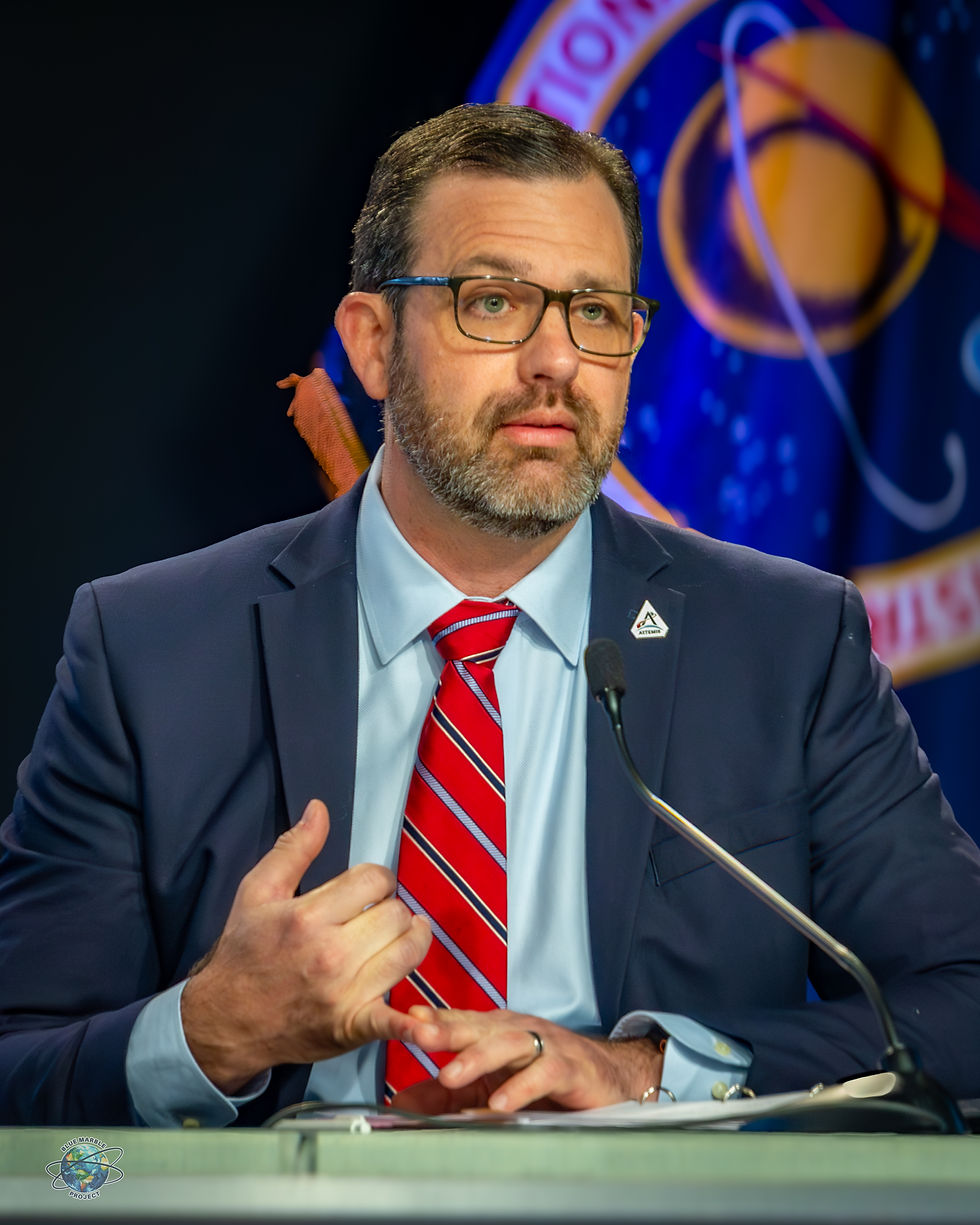
Artemis Program Manager Jeremy Parsons described a baseline mission duration of approximately 14 days, with flexibility to extend the mission if necessary.
"Every piece of this mission in Earth orbit is designed to reduce risk before we put astronauts back on the Moon," Parsons explained.
The mission will involve three spacecraft launched aboard three separate rockets, an unprecedented integration campaign for NASA. The objective is to demonstrate that Orion can safely rendezvous, dock, and operate with two different commercial lunar landing systems during a single mission.

First Stop: Blue Origin's Blue Moon Lander

The Artemis III mission sequence will begin with Blue Origin launching a test version of its Blue Moon Mark 2 lunar lander into a circular low Earth orbit approximately 273 miles above Earth.
The lander will be capable of remaining in orbit for up to 30 days, providing flexibility for launch scheduling and spacecraft readiness assessments.
Once the Blue Moon test article is confirmed to be operating properly, NASA plans to launch the four-person Artemis III crew aboard Orion using the SLS rocket from Kennedy Space Center.
Orion will initially enter an elliptical orbit approximately 18 by 1,122 miles above Earth before performing a series of maneuvers to reach a circular orbit of approximately 345 miles.
During the first two days of the mission, astronauts will conduct spacecraft checkouts, prepare for proximity operations, and begin the orbital maneuvers necessary to rendezvous with Blue Moon.
Following a successful docking, astronauts will enter the lander and spend approximately two days evaluating its systems.
These activities will include examining the crew cabin, controls, avionics, environmental control and life-support systems, and the spacecraft's ability to maintain appropriate atmospheric conditions and pressure.
The demonstration will also allow engineers to evaluate spacecraft software, guidance and navigation systems, communications, and the coordination required between multiple mission control teams.
Importantly, it will provide the first opportunity for astronauts to evaluate many of Blue Moon's integrated flight systems while operating in space.
Second Stop: SpaceX Starship

After completing operations with Blue Origin's lander, Orion will undock and reposition for another rendezvous and docking demonstration, this time involving SpaceX's Starship Version 3 test article.
SpaceX plans to launch Starship from Florida later in the Artemis III mission.
Unlike Blue Moon, which is designed to remain in orbit for an extended period, the Starship test article will have a shorter orbital lifetime. Its launch will therefore be carefully timed to support the second docking demonstration.
Starship will operate in a lower orbit of approximately 206 nautical miles and will feature an additional docking system installed near its forward end.
Orion will rendezvous and dock with Starship during a demonstration expected to last up to two hours.
Unlike the Blue Moon demonstration, astronauts will not enter Starship during this test.
NASA and SpaceX will evaluate spacecraft controllability, communications, software performance, and docking operations. The demonstrations will test two different docking configurations, with Orion connecting alongside Blue Moon's crew cabin and later to Starship's nose-mounted interface, providing valuable experience with both lunar lander designs.
Human Factors and Crew Performance Take Center Stage
Beyond testing spacecraft hardware, Artemis III will evaluate how astronauts interact with onboard systems and perform their duties in space. Following the Starship demonstration, the crew may have up to five additional days for scientific investigations and technology testing, including evaluations of survival suits, docking sensors, acoustic and thermal conditions, and human factors. These assessments will help engineers understand how spacecraft design, equipment, and environmental conditions affect crew comfort, workload, and performance.
Preparing Astronauts for Greater Autonomy
NASA will investigate how astronauts can conduct health assessments without direct communication with Mission Control, an important capability for future missions where communication delays and limited resources require greater crew autonomy. Artemis III will also evaluate coordination between astronauts and flight controllers during complex docking operations. From a human factors perspective, these studies will help improve spacecraft design, crew training, and operational procedures for future lunar and Mars missions.
Biological Science and Additional Research
Artemis III will support several scientific investigations, including cellular biology research, lunar sample-return procedures, and assessments of potential spacecraft contamination. Astronauts will also conduct Earth and solar observations, while plant seeds flown aboard Orion will support future research and educational activities. Together, these studies will help advance NASA's understanding of human spaceflight and preparations for future lunar and deep-space missions.
Preparing Artemis IV for the Lunar Surface

While Artemis III focuses on validating spacecraft systems in Earth orbit, Artemis IV is being developed to accomplish the next major milestone: returning astronauts to the lunar surface.
NASA officials discussed several areas of hardware development and preparation.
Work on the Orion heat shield is progressing, while processing and testing activities involving RS-25 engines continue at NASA facilities, including Stennis Space Center in Mississippi and the Michoud Assembly Facility in Louisiana.
The mission also will incorporate an upgraded upper-stage configuration, including a stretched Centaur stage designed to accommodate additional propellant.
Together, these systems will support the increasingly complex launch and mission requirements associated with human lunar exploration.
A New Generation of Lunar Spacesuits

Axiom Space is developing the Axiom Extravehicular Mobility Unit (AxEMU), a lunar spacesuit weighing approximately 250 pounds on Earth. Designed to provide mobility, life support, and environmental protection, the suit will support two planned EVAs during Artemis IV. Engineers must account for the Moon's partial gravity, abrasive regolith, and uneven terrain while minimizing astronaut fatigue and physical strain. Lessons learned will help improve spacesuit design for future lunar and Mars missions.
Inside Kennedy Space Center's Vehicle Assembly Building
The press conference also included a live update from NASA's Vehicle Assembly Building (VAB), where Megan Cruz reported on preparations for upcoming Artemis missions. The SLS core stage was positioned horizontally in a high bay for weighing and processing, with plans to return it to a vertical position the following week for integration with the solid rocket boosters. Once fully assembled and tested, the rocket will move to the launch pad for final preparations, including fueling operations. The activity inside the VAB highlighted the ongoing work behind NASA's efforts to return astronauts to the Moon.
Why This Approach Matters
NASA's updated Artemis strategy emphasizes incremental testing, operational experience, and the integration of human and technological systems. By testing life support, docking procedures, crew interfaces, and spacecraft coordination during Artemis III, NASA aims to reduce risks before returning astronauts to the lunar surface. Partnerships with SpaceX, Blue Origin, and Axiom Space add complexity, requiring close coordination between spacecraft, crews, and mission control teams. The lessons learned will help refine procedures, strengthen crew safety, and prepare NASA for future lunar and deep-space exploration.
The Road Back to the Moon
More than five decades after Apollo 11, NASA is preparing for another chapter of human lunar exploration. The goal is no longer simply to demonstrate that humans can reach the Moon. Artemis is intended to establish the foundation for returning repeatedly, conducting scientific investigations, developing new technologies, and preparing for missions farther into the solar system. With Artemis III targeting critical demonstrations in low Earth orbit in 2027 and Artemis IV intended to return astronauts to the lunar surface in 2028, NASA has established an ambitious timeline. Meeting that schedule will depend on successful hardware development, integrated testing, mission readiness, and the resolution of technical challenges. For the engineers, scientists, technicians, mission controllers, and astronauts working toward that goal, the next several years will be consequential.
And for those of us watching from Earth, Artemis offers an opportunity to witness something that has not happened since Apollo 17 in 1972: human footsteps on the Moon.
This time, the objective is not simply to return. It's to build the capabilities that will allow humanity to keep exploring.
References
NASA. (2026, October 23). NASA shares Artemis acceleration plans for Moon missions. NASA.
NASA. (n.d.). Artemis. https://www.nasa.gov/artemis/
NASA. (n.d.). Orion spacecraft. https://www.nasa.gov/orion/
NASA. (n.d.). Human Research Program. https://www.nasa.gov/hrp/
NASA. (n.d.). Space Launch System. https://www.nasa.gov/sls/


Comments